I started this blog on February 14, 2023, with a story about how I introduced my family to ChatGPT by writing a story for my grandson. It was a story about writing a story, and about how it feels to collaborate with AI to produce something. I want to write more about that topic – what it means for us to start using the new AI technology coming our way, but the news this week calls for some real-time commentary.
I’ve written about Bing Chat, which was launched because Microsoft wants to take market share for search from Google. New Bing was announced the day after I started a blog, which was convenient for me! Then Google announced it has a similar technology called Bard, which it then launched to a select preview audience. So that’s one front in the AI war – search, which is currently dominated by Google.
The second front in the AI wars is a battle that came into view this week in office productivity. Microsoft dominates this front with its eponymous Office suite – Word, Excel, and PowerPoint, being the central players. Google announced today that it will incorporate AI into its Workspace suite of products, which it hopes to make competitive with Microsoft. If you never heard of Google’s Workspace, don’t worry – you also may have never “Binged” something on your phone – you Googled it. That’s how lopsided the second front is – this one in Microsoft’s favor.
https://www.theverge.com/2023/3/14/23639273/google-ai-features-docs-gmail-slides-sheets-workspace
The AI battle is forcing Microsoft and Google to plow forward with implementing the new generative AI – including the Chat GPT-like “language model” AI, which I’ve written about, and now, suddenly, they are going to include image generation, which I haven’t written about. When they put the two together, they call it multi-modal AI, and multi-model will also soon extend to video image generation, which I’ll have to write about another day soon.
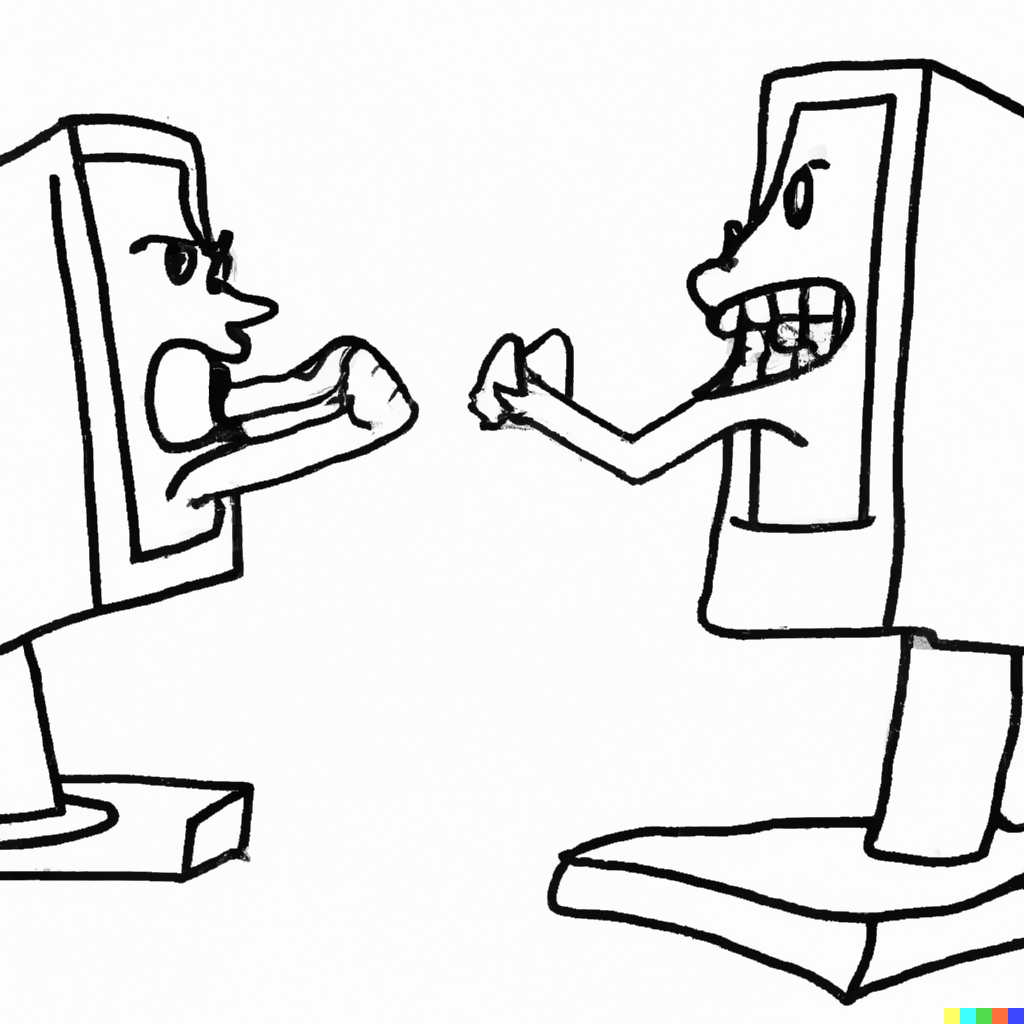
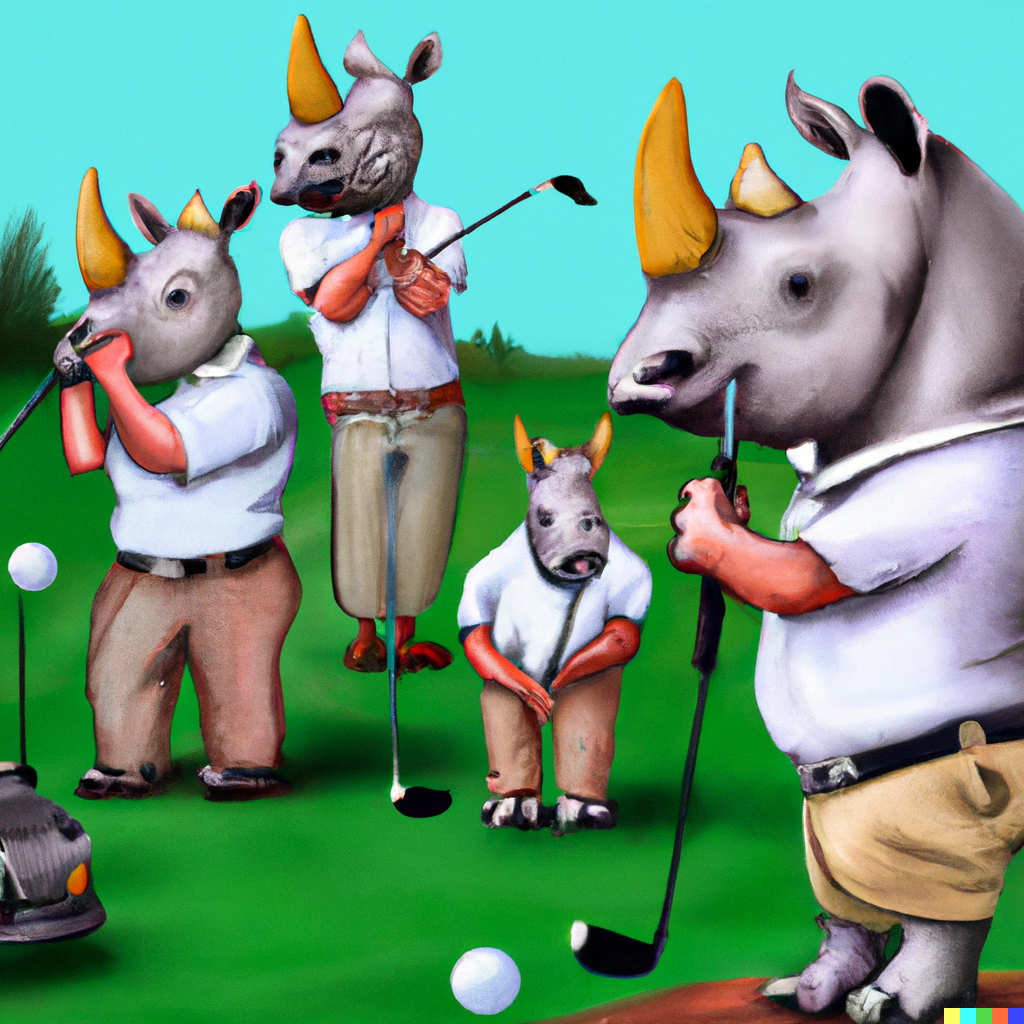
As with Chat GPT, it was OpenAI that launched a text-to-image product to the general public. It is named DALL-E, a blend of “Dali” as in Salvador, and WALL-E, the movie character robot. I’ve been meaning to try out DALL-E, and finally signed up for it last week. It’s pretty cool. My last name, Rinehart, has garnered the nickname “Rhino” over a few generations, and my family like to golf, so I generated an image of Rhinos golfing. It only took me a few tries to get one I liked, which is pretty impressive technology. I used DALL-E for the intro image for this post, too. Also a quick effort.
So the events of the week pushed me forward in using an image generator for the first time, because I read that Google and Microsoft are planning to incorporate both types of AI into their products. As fast as they can, of course.
The problems with the text generators are well known – they can generate biased, offensive, and otherwise highly objectionable content. So it will be interesting to see how this plays out as people use it in Word, PowerPoint, and email. I’m sure Microsoft is rushing to clean up its output, but I still expect some rough edges when its released.
The main problem with the image generators is that the AI are trained on art composed by human artists, and it then renders new images in their style. A form of plagiarism. The first big legal battle on this front is underway, with Getty images suing Stability AI for its image generator Stable Diffusion, which is similar to DALL-E.
Microsoft has barely begun adapting its Bing Chat to suit different use cases. In my last post, I described how the Sydney affair arose from a failure on Microsoft’s part to design a search product separately from the social chat that is wrapped up in the same Chat GPT technology. This week, Microsoft added another useful distinction by putting a “Compose” button next to the Chat button.
Search, Compose, and Chat are arguably three different products. They are certainly different use cases. Launching one tool to do all three was a mistake. Microsoft is starting to correct that mistake this week, by adding a layer of controls to drive the underlying AI towards the appropriate response for each use case.
The rush to get AI products into the market is going to result in bad user experiences until the design and user research efforts are able to catch up. As the stakes get higher, the magnitude of the problems will increase. There will be confusing times at the office with the new products, apparently pretty soon, but more AI tech is in the pipeline and it’s impacts will be more consequential than a rough day at the office.
The Alignment and Safety problems that I touched on briefly last month are also well known and will be hard to overcome. The rushed releases we’re seeing this week are the worst way to proceed as the AI gets more powerful. Microsoft is certainly pushing AI out before it’s well-vetted. Google appears to be under pressure to respond in kind. What we’re seeing this week should add urgency to efforts to get the public and policy makers engaged on oversight of the more powerful AI tech coming soon.
Good news on that front – the National Institute for Standards and Technology (NIST) has launched a Risk Management Framework for AI, which is a significant first step toward AI governance. I’ll write about that, and its implications for AI policy-making soon.

 Make Up Your Mind
Leave a comment