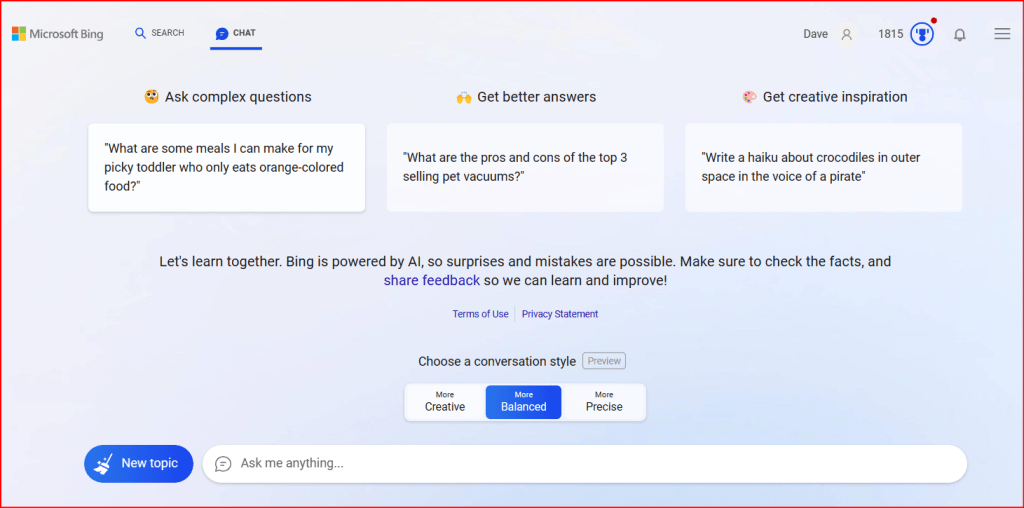
Microsoft has started making changes to its Bing chat interface. The screenshot I posted here is from March, 2023. It’s different than it was in February, and I expect it will continue to evolve.
In its rush to get its shiny new technology object into the market, Microsoft launched a tool that can do very different things, but was not designed to do any of them well.
Notice two of the top statements in the screenshot about what you can do here: “Get better answers” or “Get creative inspiration.” These are what IT people call “use cases.” And the chat launched in February did not provide a means of getting the chat bot to change its output to match the use case. Now notice the three buttons just above the search box: More Creative, More Balanced, More Precise. These are new. A small step in the right direction.
When Microsoft released Bing Chat, the main long-term objective was to get people to use Bing instead of Google. Then came the wild stories about Sydney, a bizarre character who emerged during extended chat sessions. How is it possible that a tool that is supposed to compete with a Google search could produce such an extremely inappropriate and seemingly completely unrelated (to search) user experience?
The problem is a classic mistake that technology companies make. They launch a new technology without designing a product that makes use of the underlying technology.
A chatbot that engages a user in a human-like conversation, takes on a persona to seem more human, and asks the user questions about their feelings, is not a search tool. I call it a social chat bot. Social chat bots have been around for some time now, and the new AI technology makes them a lot more interesting, but a social chat bot is not suitable for a search engine. It was the social chat bot that became Sydney, and wanted to wreck Kevin Roose’s marriage.
In his March 10, 2023 podcast, Kevin said he’s still mystified about what happened to him last month, and why this strange encounter occurred. My contention is that the social bot had no business living in the same bot as the Bing chat bot. But it was already in there when they got it from OpenAI, so they left it in there.
Adding a More Creative button for a social chat, and a More Precise button for an information search is a step in the right direction, but it’s superficial, and there’s more to do to take inappropriate social bot interactions out of the search. One of the most common use cases for search is to get medical information. Asking questions about symptoms and treatments is obviously tricky for any search engine.
I tried a few with Bing, and it was clear that they were trying to be responsible with giving medical information, but the social bot made it a strange experience. It asked me “do you have any of these symptoms?” and had a wide-eyes (“alarmed”, I guess) emoji. And when I responded “yes” without specifying which one, it recommended I “seek medical attention immediately”, which is not appropriate if you have one or two of the minor symptoms. And then it said “I hope you feel better soon!” with praying hands emoji.
“I hope you feel better” is the appropriate response for a human to offer when they learn someone is not feeling well. I understand why the bot generated that response – that’s what it’s designed to do. But when a bot says “I hope” – its being disingenuous. It is not capable of hope, or any other emotions it is programmed to say that it has. If you want to have a conversation with a make-believe person, a social bot behaving this way makes sense. But if I’m doing a search for information, I don’t want to get an answer from Sydney.
It will be interesting to see how Microsoft handles this going forward, and if Google adds chat to its search, it will be interesting to compare how they handle the social bot experience that seems to show up where it does not belong.

 Make Up Your Mind
Leave a comment