I created a WordPress account about 10 years ago, thinking at the time that it was about time I get started on my long-overdue goal to start writing. Here I go again. If you’re reading this, I did it!
Writing takes inspiration. For me, this time, my inspiration is a beautiful blonde toddler named Charlie, and the absolute delight he showed when I read him a story in which he and his friend were the heroes.
I spent a lot of time thinking about what sort of story I would ask Chat GPT to write. I had read Charlie lots of stories, and he is in the truck-obsessed phase that is familiar to friends of toddlers. He’s especially enamored with excavators, and his toy excavator is is favorite. He has a good friend named Megan, so I wanted to include her. It’s about a half hour drive to his house, and I had the story in mind when I started, and thought about it all the way there.
So when the time came, I asked Chat GPT to write a rhyming children’s story about a little boy named Charlie and his friend Megan, who use Charlie’s toy excavator and Megan’s creativity to help a real excavator that got stuck in the mud while working near Charlie’s house. I borrowed the part about helping a truck that was stuck in the mud from one of his stories, and made it about him.
Here’s what it wrote:
” Once upon a time, in a land not too far, Lived a boy named Charlie, who had a shining star, He loved to play with toys and make-believe, And his best friend Megan, was always there to weave.
One day, while playing near Charlie’s house, They heard a loud noise, like a mouse, They ran outside to see what was the matter, And found a big excavator, stuck in the mud like batter.
The driver was worried, he couldn’t move an inch, And Charlie and Megan, wanted to help in a pinch, But how could two kids, save such a big machine, With just their toys and imagination, it seemed quite extreme.
But Charlie had a plan, and a toy excavator too, And Megan had an imagination, that was brand new, So they put on their thinking caps, and got to work, And soon enough, their plan, began to perk.
They dug and they scooped, with Charlie’s toy machine, And Megan made believe, that they had a big diesel engine, And before long, the real excavator was free, Thanks to their teamwork, as you can see.
The driver was grateful, and gave them a cheer, And Charlie and Megan, beamed with pride and a tear, They had used their toys and imagination, to save the day, And proved that together, they could make anything okay.
So whenever you’re stuck, and don’t know what to do, Just remember Charlie and Megan, and their rescue, With a little bit of imagination, and a toy or two, You can do anything, just like they did, it’s true!
I was pretty pleased with how it came out. I tried a few other stories that my family members suggested on the fly. Charlie was napping when I showed my family Chat GPT for the first time, and we created some stories together with ideas from each in turn.
When Charlie woke up, I read him the first story. He smiled broadly. It was a hit. Then I started to read him a second story. We were immediately aware that he was used to stories with pictures, and we were pushing it to try for another “all words no pictures” story. So we let him go play and waited for another chance later.
After dinner, we got through the other stories. With a three-year-old boy, there was some squirming and looking around, but he seemed to take most of the stories in and seemed to enjoy them.
Then he said “Read me the one about me and Megan (again)”. So I did, and he smiled and squirmed. He went to play and came back. “Read it again!” I did. He smiled, squirmed, seemed to fully love that he was the hero of this story, which is what I had in mind.
Then a funny thing happened in my mind. I knew that I had put a lot of thought into this story. I knew that I had thought about a lot of key factors, like asking for a “rhyming story” specifically, and so on. So I felt like I had succeeded. Charlie was happy, I was happy.
But I didn’t write the story. Chat GPT did. But it was my story for Charlie, Chat GPT didn’t know Charlie and didn’t “know” what would appeal to him, particularly. I also thought that Megan would like it, too. I had met Megan and her parents at Charlie’s birthday party. I wanted to ask my son to send them the story. My story. The Chat GPT story. It really was both, and the idea of it was appealing for both reasons.
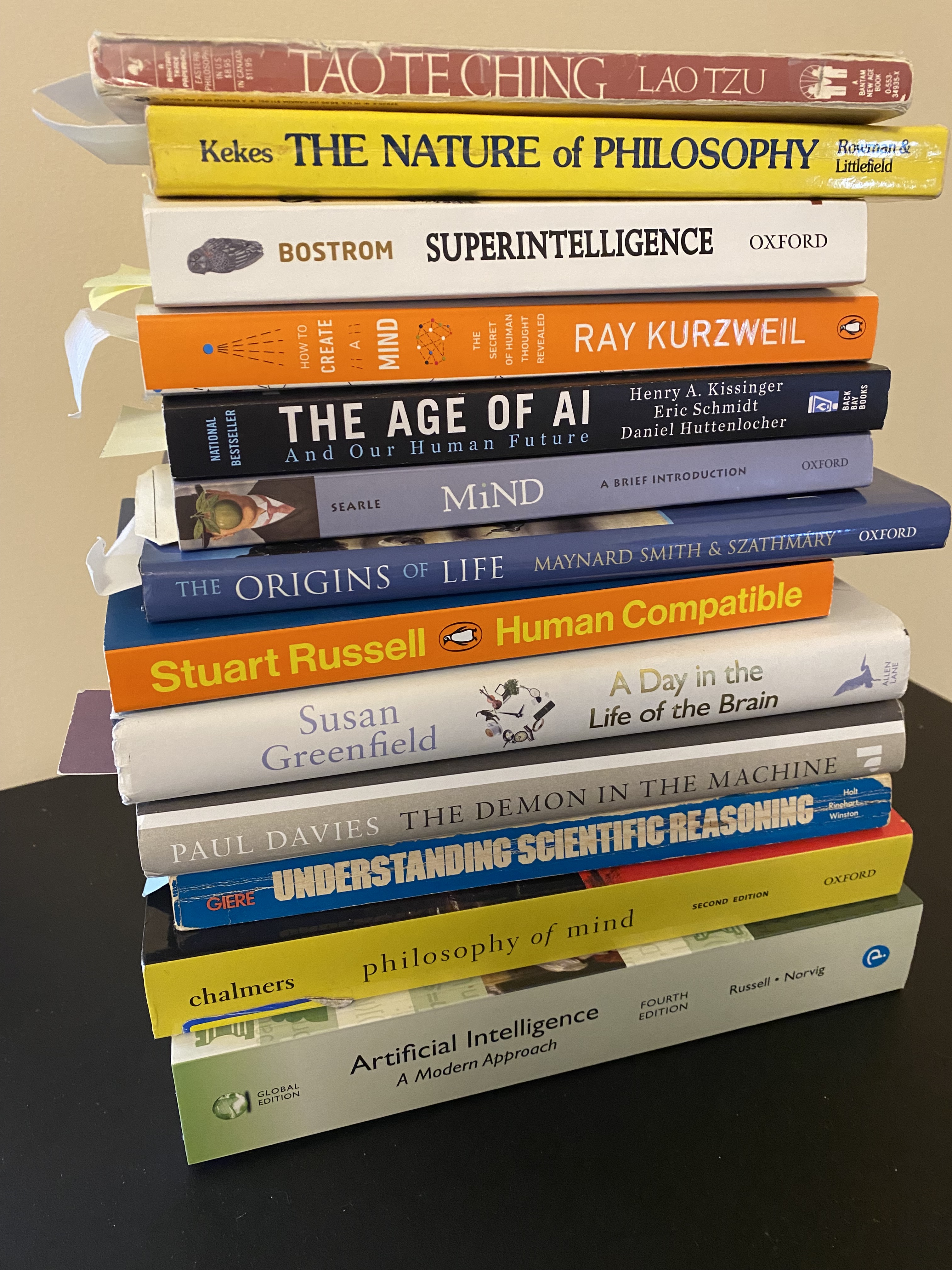
I had bought several books on AI a few years ago, thinking I could tie in my psychology degree, with a minor in philosophy, and maybe learn enough about this new technology to help explain it to others. I discovered a series of lectures by a Berkeley philosopher named John Searle, on the philosophy of mind, language, and society, and I felt like there was work to do to join Searle in countering some misconceptions about AI that he was battling – “militating against” in his words.
Over the decades, with each new wave of success in the development of AI, some of the same fears arose, and took on new urgency. The fear that an artificial intelligence would rise up and take over – like HAL in 2001, A Space Odyssey. Or the fear that robot would take over our jobs.
Searle had a lot to say about the first. Chat GPT was clearly an example of the second. A robot that can write pretty good stories. If you write stories for a living, it’s got to be a concern.
I’m one of many people working in the technology space that was laid off during the wave that hit at the end of 2022 and early 2023. Losing a job is a blow to one’s self-image. What we do for a living is inextricably linked to who we are. What if you write for a living? What does Chat GPT mean for your future?
On the question of robots rising up against humans, Searle is quick to point out that AI is merely doing “computation”. The computer is manipulating symbols and doing math following algorithms. It is not aware of the meaning of the symbols. It’s not aware of anything. It’s not conscious. It isn’t capable of “wanting” to rise up. It has no “intentionality” and no sense of self upon which to attach a desire.
But we humans do. As Charlie’s “Papa” I was full of intentions. Intentions toward Charlie, his parents, his Nana, his friend Megan, her parents. I was thinking about all of these people when I was thinking about the story I wanted to write for Charlie. I hoped that Charlie would be happy, and I hoped that all of these people would share in the happiness. It was a great experience, thinking about a story for him, anticipating how it would come out. Hoping he’d like it.
The story was a product of my mind. It was a product of my imagination. It was a product of my intentions. I made it happen and felt better about myself. When Chat GPT writes a story, it is following an algorithm defined by the words I write to instruct it. It does a lot of impressive work interpreting what I wrote, but it doesn’t know what it’s writing.
The ego-involvement I had is interesting thing to me about this particular experience. Of course I wanted Charlie and others to be happy, but I also wanted them to appreciate me for making this happen. Chat GPT wrote it, but I feel completely justified in taking the credit for the story.
I wanted to be appreciated for being insightful, knowing what matters to Charlie, for including Megan, for asking Chat GPT to make it a “rhyming” story. I wanted to be appreciated for being knowledgeable about AI, about Chat GPT, for being one of the early adopters. I wanted my son to know I had signed up for a subscription – I was one of the first to do so.
Driving home that night, I suppose my endorphins were flowing from the joy of holding my squirming, smiling grandson as I read him the story for the third time. It was the best moment of a week that included some pain around being unemployed, and some trepidation about spending a lot of hours reading about AI, instead of networking to find my next job.
I spent a lot of hours reading about Chat GPT, Bard, Bing, the “AI arms race” declared by the media. I finished several books I had bought a few years ago on AI “How to Create a Mind” by Kurzweil, “A Day in the Life of the Brain” by Greenfield, “Superintelligence” by Bostrom. As as I picked them up to get through the remaining hundreds of pages, I also checked the publication dates, and was painfully aware that at the end reading all of this, I would be sorely out-of-date.
I spent a lot of hours online, on Wikipedia, watching neuroscience lectures from an MIT open course on the Brain, by Nancy Kanwisher. It’s incredible how much more is known about brain functions now than when I studied psychology decades ago. In the first lecture, Dr. Kanwisher said “there isn’t a textbook for this class, because in the time that it takes to write and publish a textbook, it would be out of date – this field is moving too fast.”
Wow, OK, I’m trying to catch up on the technology, the philosophy, and the neuroscience underpinning AI, and once again, when I finish this lecture series from 2019, I’ll be behind the times. Today, I’m halfway through “The Age of AI” by Henry Kissinger, Eric Schmidt, and Daniel Huttenlocher; copyright 2021 – I’m getting warmer.
One of the themes in “The Age of AI” is the notion that AI, when it starts to actually perform at the level of humans (or better, as has happened with Chess, and other games), it will change those of us who work with it. It will be a partnership between us, sentient, intentional, conscious humans, and a non-human but intelligent partner.
I think we struggle with the word “intelligence” as something that can be produced in a machine, because we think of intelligence as something in people’s minds. But machines themselves are not intelligent, in the sense that they actually are aware of what they are doing – they are not aware.
They are being made to produce intelligent output. They do so at the direction of the algorithms defined for them by humans. The authors of “The Age of AI” say of people interacting with AI – “these users are entering into a form of human-machine dialog that has never existed.”
This new form of human-machine dialog has already begun, but with Chat GPT, the new Bing, Bard, and other new public-facing AI products, it is going to be a mainstream issue. The question “should we be afraid of losing our jobs to AI?” is a live issue. It is not new, but the example of how it might happen is new, in the quality of writing that Chat GPT can produce.
Fortunately for for humans who are currently employed, Chat GPT has well-known problems. It makes mistakes. It’s answers can carry the bias that exists in its training data forward into the answers it gives to questions. Google’s Bard make a much-ballyhooed mistake in its initial advertisement, causing Google’s stock to drop. Bing will make mistakes, too. These technologies are very good, but not near human-level proficiency in important ways. Fiction, they do pretty well. Factual information, reliable and unbiased information – not so much, not yet.
So for my first blog, Chat GPT was part of the story, but it didn’t write this post. This is all me. Charlie’s Papa, and a student of what’s happening with AI in the world Charlie is growing into.
Making Charlie and my other grandchildren happy is a central theme in my life from now on. It’s part of my evolutionary makeup as a human being. Writing about my human perception of what’s happening to myself and others around me in the face of ever-changing technology feels like something worthwhile.
No robot will ever write my life’s story for me. I wrote a story about writing a story. I have done a lot of thinking about thinking. As AI continues to become part of our lives, we can be certain that our humanity is our competitive advantage and the thing that only we can bring to bear on the work that we do.

 Make Up Your Mind
Leave a comment